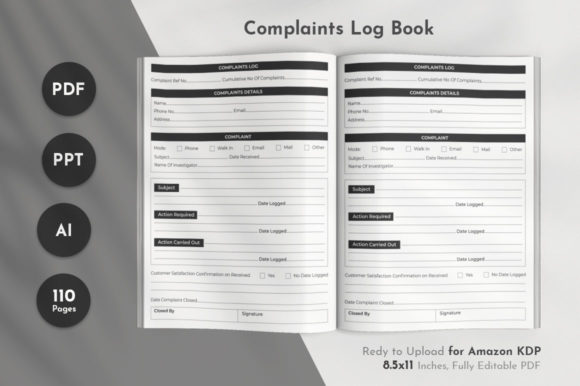
Complaints Log Book KDP Interiors: Streamlining Low-Content Publishing Workflows
For self-publishers and digital entrepreneurs, the bottleneck in building a profitable Amazon KDP portfolio is often not the idea generation but the technical execution. Creating high-quality, functional interiors from scratch requires significant time investment in design software, formatting checks, and bleed calculations. This is where specialized assets like Complaints Log Book KDP Interiors serve as critical workflow accelerators. Rather than viewing these templates merely as pre-made pages, successful publishers integrate them as foundational components of a broader content production system. These interiors bridge the gap between identifying a niche demand and having a live, professional product available for purchase, effectively reducing the turnaround time from weeks to hours.
The specific utility of this interior lies in its structural readiness. Designed with 110 total pages, including a dedicated business information page and 109 formatted log entries, it addresses a precise B2B need. Businesses require standardized documentation for customer service tracking, quality assurance, and regulatory compliance. By utilizing a pre-formatted template that adheres to the standard 8.5″ x 11″ dimension, publishers eliminate the risk of rejection due to margin errors or gutter miscalculations. The asset functions as a verified baseline, allowing creators to focus their energy on keyword research, cover design, and marketing strategy rather than repetitive layout tasks.
Technical Specifications and File Compatibility
Integrating this resource into your publishing pipeline requires an understanding of the included file ecosystem. The package is designed for versatility across different skill levels and software preferences. The .ZIP file contains four distinct asset types, each serving a specific function in the creation process:
- Ready-to-Upload PDF: This is the primary deliverable for users who want immediate deployment. It has been tested for Amazon KDP standards, ensuring correct margins, bleed settings, and resolution. For publishers operating on tight schedules, this file allows for same-day listing creation.
- Adobe Illustrator (AI) File: Essential for designers who wish to modify vector elements, adjust fonts, or rebrand the interior. This source file provides granular control over every line and text box, enabling the creation of unique variations to avoid duplicate content penalties.
- PowerPoint (PPT) File: A crucial inclusion for non-designers. PowerPoint offers a familiar interface for editing text, adding logos, or adjusting spacing without requiring expensive graphic design software. This lowers the barrier to entry for entrepreneurs whose expertise lies in marketing rather than design.
- JPG Files: High-resolution image files useful for creating mockups, social media promotional materials, or A+ Content for the Amazon listing. Visualizing the interior helps potential buyers understand the product’s utility before purchasing.
This multi-format approach ensures that the Complaints Log Book KDP Interiors remain accessible regardless of your technical stack. Whether you are a seasoned designer using industry-standard tools or a new publisher leveraging office software, the asset adapts to your existing workflow rather than forcing a software migration.
Strategic Implementation in Niche Research
Before uploading any low-content book, validation is necessary. This interior should be deployed only after confirming market viability. Use the template as a prototype during the research phase. Load the PDF onto a tablet or print a test copy to evaluate usability. Does the writing space accommodate detailed complaint descriptions? Are the fields relevant to current business practices? This tactile review process informs your listing copy and helps identify unique selling propositions.
Furthermore, this interior interacts directly with your keyword strategy. Because the layout is fixed, your metadata must align with the specific fields present in the log. If the interior includes sections for "Resolution Status" or "Follow-Up Date," your backend keywords and title should reflect these features. This alignment improves search relevance and reduces return rates caused by mismatched expectations. The template acts as a constraint that sharpens your SEO focus, preventing the common mistake of targeting broad terms for a highly specific product.
Customization and Brand Differentiation
While the ready-to-upload PDF offers speed, long-term success in KDP often requires differentiation. Using the editable AI or PPT files allows you to transform a generic complaints log into a niche-specific tool. Consider adapting the header to include industry-specific terminology. A log book designed for healthcare facilities differs significantly from one intended for retail stores or automotive repair shops. By modifying the column headers or adding a specialized introductory page, you create a distinct product that serves a narrower, less competitive audience.
Branding is another layer of integration. Utilize the business information page to add value. You might include space for company mission statements, return policy summaries, or escalation flowcharts. These additions transform the book from a simple notebook into a business operations manual. When customizing, maintain consistent typography and spacing to preserve the professional aesthetic established in the original template. Consistency signals quality to buyers browsing the "Look Inside" feature on Amazon.
Quality Control and Pre-Publication Testing
Even with tested templates, quality control remains the publisher's responsibility. Before final submission, run the customized file through Amazon’s Previewer tool. Check specifically for content shifting near the gutter, especially if you have added text or graphics to the inner margins. Verify that the business information page aligns correctly with the subsequent log pages. Printing a physical proof is highly recommended for log books, as paper weight and ink absorption affect writability. Ensuring the end-user experience is frictionless protects your account health and generates positive reviews.
Efficiency in this stage comes from creating a checklist based on the template’s specifications. Since the dimensions (8.5″ x 11″) and page count (110) are constant, you can standardize your QC process. Documenting any changes made to the master files prevents version control issues later. If you plan to release a series of related business logs, maintaining a change log ensures consistency across the entire brand lineup.
Scaling Your KDP Business Portfolio
The true power of acquiring fully editable interiors lies in scalability. Once you have successfully published a Complaints Log Book, the workflow becomes repeatable. The same customization techniques applied here can be adapted for incident reports, maintenance logs, or visitor sign-in books. The PPT and AI files serve as master templates for future projects, drastically reducing the setup time for subsequent releases.
This asset also supports cross-promotion strategies. The included JPG files facilitate the creation of bundled offerings or companion products. You might pair the complaints log with a customer satisfaction survey book or a staff training journal. By treating the interior as part of a larger ecosystem of business tools, you increase the average order value and build a recognizable brand presence within the B2B low-content category.
Long-Term Asset Management
Sustainable publishing requires organized asset management. Store the original .ZIP file and all modified versions in a structured cloud directory. Label files clearly with version numbers and niche targets. This organization prevents accidental uploads of outdated drafts and streamlines future updates. As Amazon’s guidelines evolve, having access to the source AI and PPT files allows you to quickly update interiors to meet new compliance standards without redesigning from scratch.
Additionally, monitor performance metrics to inform future iterations of this interior. If customers consistently mention in reviews that they need more space for signatures or additional tracking columns, use the editable files to create a "Version 2.0." This responsive approach to product development turns a static template into a dynamic asset that evolves with market demands. The initial investment in a high-quality, editable interior pays dividends through reduced production costs, faster iteration cycles, and improved product-market fit.
Ultimately, Complaints Log Book KDP Interiors represent more than just a collection of formatted pages; they are a leverage point for serious publishers. By integrating this resource into a disciplined workflow encompassing research, customization, quality assurance, and portfolio scaling, creators can build a robust publishing business with greater efficiency and professionalism. The combination of ready-to-use convenience and deep editability makes this asset a practical foundation for anyone looking to streamline their KDP operations while maintaining high standards of quality and relevance.