Streamlining Production with Scuba Diving Logbook KDP Interiors
For low-content and medium-content publishers on Amazon KDP, the bottleneck is rarely the idea; it is the execution. Creating a functional, compliant, and aesthetically pleasing interior from scratch for every new niche consumes valuable time that could be spent on market research, cover design, and marketing. This is where pre-made Scuba Diving Logbook KDP Interiors function as a critical workflow accelerator. Rather than viewing these assets merely as digital files, successful publishers integrate them as foundational infrastructure within a broader publishing system. These interiors serve as the standardized chassis upon which unique products are built, allowing creators to bypass technical formatting hurdles and focus entirely on differentiation through cover design and metadata strategy.
The Role of Pre-Made Interiors in Publishing Workflows
In the context of a professional publishing business, Scuba Diving Logbook KDP Interiors represent more than just lined paper or tables; they are validated templates that reduce operational risk. When developing a product line for the diving niche, the interior must adhere to specific industry standards regarding data tracking (depth, time, gas mix, conditions) while simultaneously meeting Amazon’s strict printing specifications. A high-quality pre-made interior bridges the gap between niche utility and platform compliance.
This asset fits into the workflow at three distinct stages:
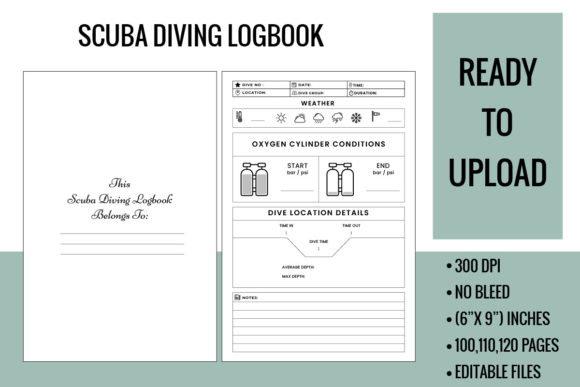
- Pre-Production Validation: Before investing hours in design, the interior confirms that the 6’’×9’’ trim size with no bleed is viable for the intended content volume. It acts as a proof-of-concept for the page count strategy.
- Parallel Development: While the interior is ready for immediate upload, the creator can simultaneously work on the cover. Because the page counts (100, 110, 120) are fixed and known, spine width calculations are precise, eliminating the common error of designing a cover before finalizing the interior.
- Post-Launch Scaling: Once a baseline product is live, these interiors allow for rapid iteration. Publishers can test different cover styles against the same proven interior to isolate variables and optimize conversion rates without altering the user experience inside the book.
Technical Specifications and Quality Assurance Integration
Reliability is paramount when integrating third-party assets into a commercial workflow. The specific technical parameters of these Scuba Diving Logbook KDP Interiors are designed to align with Amazon’s current ingestion requirements. Understanding these specs prevents rejection during the automated review process and ensures a professional physical product.
Resolution and File Integrity
The inclusion of AI source files at 300 DPI is a non-negotiable standard for print readiness. In many workflows, publishers may need to make minor adjustments or verify element placement. Having the vector-based source file ensures that any inspection or modification maintains crisp lines and legible text, which is essential for logbooks where divers record small, detailed data points. Rasterized PDFs alone can sometimes obscure errors; the AI file serves as the master reference for quality control.
Trim Size and Bleed Configuration
The 6’’×9’’ no-bleed configuration is strategically chosen for this niche. Dive logbooks are functional tools often used in wet or cramped environments; a compact trim size enhances portability. From a production standpoint, "no bleed" simplifies the upload process and reduces the margin for error regarding safe zones. However, this requires disciplined adherence to margins. Since these interiors are tested on KDP, they already account for the gutter space necessary for binding, ensuring that writing areas do not disappear into the spine. This pre-validation saves publishers from the costly cycle of uploading, receiving an error report, adjusting, and re-uploading.
Page Count Strategy
Offering variations of 100, 110, and 120 pages allows for strategic pricing and positioning. In a competitive marketplace, having multiple SKUs with slight variations can capture different segments of buyer intent. A 100-page version might serve as an entry-level travel log, while the 120-page version targets serious professionals or instructors. Because these interiors are instant downloads in PDF format, maintaining this inventory of options adds zero storage overhead while significantly expanding catalog depth.
Integrating Interiors with Cover Design and Metadata
The prompt explicitly states: "You just need to create a unique cover design." This highlights the division of labor in modern KDP publishing. The interior provides the utility; the cover provides the click. When using Scuba Diving Logbook KDP Interiors, the creative workflow shifts almost entirely to external presentation.
Because the interior structure is fixed, cover designers can work with certainty. There is no guesswork regarding spine width calculations for the 100, 110, or 120-page variants. This compatibility streamlines communication between authors and freelance designers. You can provide the exact page count and trim size immediately, ensuring the first draft of the cover is technically accurate. Furthermore, knowing the interior contains specific diving tables or prompts allows for more authentic cover imagery. Instead of generic ocean stock photos, covers can feature specific equipment or terminology that mirrors the interior content, creating a cohesive brand promise that increases customer satisfaction and reduces returns.
Workflow Efficiency and Asset Management
For entrepreneurs managing multiple niches, organization is as important as creation. Integrating these interiors requires a systematic approach to digital asset management.
- Centralized Repository: Store the PDF and AI source files in a cloud-based system tagged by niche, trim size, and page count. This prevents version confusion and ensures you always grab the "Tested on KDP" verified file rather than an outdated draft.
- Naming Conventions: Adopt a strict naming protocol (e.g., ScubaLog_6x9_NoBleed_110pg_v2.pdf). When scaling to hundreds of titles, searchable filenames reduce administrative friction.
- Quality Check Protocol: Even though the asset is marketed as "100 Check quality on KDP," professional publishers implement their own verification step. Download the KDP Previewer and run the specific PDF before every upload. Treat the vendor’s guarantee as a baseline, not an absolute exemption from due diligence. This habit protects your account health over the long term.
- Licensing Compliance: Always maintain records of the purchase and license terms for these interiors. As your business grows, having clear provenance for your assets is essential for protecting your intellectual property and avoiding copyright disputes.
Strategic Considerations for Long-Term Use
While Scuba Diving Logbook KDP Interiors offer immediate speed advantages, sustainable success requires looking beyond the initial upload. The diving community is knowledgeable and discerning. Using a pre-made interior should not mean neglecting user experience. Publishers should periodically review customer feedback on similar products to ensure the pre-made layout still meets evolving expectations. If divers consistently mention that a specific column is missing or a table is hard to read, use the AI source file to customize the template. The ability to edit the source file transforms a static commodity into a proprietary asset.
Additionally, consider how these interiors interact with other business tools. For example, if you use project management software like Trello or Notion to track publishing tasks, create a template card specifically for "Logbook Launch" that includes links to these verified interiors. This institutionalizes the efficiency gain, making it repeatable for team members or virtual assistants. The goal is to move from ad-hoc publishing to a manufacturing mindset where high-quality inputs yield consistent outputs.
Finally, understand that the value of these interiors compounds over time. By reducing the production time per title from days to hours, you free up cognitive bandwidth for higher-leverage activities like building an email list of divers, running Amazon Ads, or creating companion digital products. The interior is not the end product; it is the mechanism that enables the business model. Treating Scuba Diving Logbook KDP Interiors as a professional tool rather than a shortcut aligns your workflow with long-term growth objectives, ensuring that speed does not come at the expense of quality or reputation.