Evaluating Basic Journal Notebook KDP Interiors for Professional Publishing
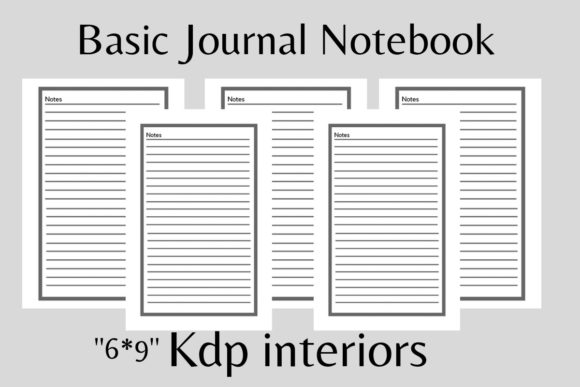
In the competitive landscape of low-content publishing, the distinction between a generic template and a viable commercial product often lies in technical precision. For self-publishers, educators, and small business owners utilizing Amazon KDP or print-on-demand services, Basic Journal Notebook KDP Interiors represent more than just blank pages; they are foundational assets that dictate production efficiency and end-user satisfaction. This specific interior format—a 6x9 inch, 99-page black and white PDF with bleed—is engineered to address the most common friction points in notebook creation: margin errors, resolution failures, and binding inconsistencies.
When evaluating this asset for professional use, it is necessary to look beyond the aesthetic simplicity and analyze its structural integrity. A pre-formatted interior eliminates the guesswork associated with gutter margins and safe zones, allowing creators to focus on cover design and niche marketing rather than troubleshooting file rejections. The following analysis breaks down the practical utility, technical specifications, and strategic application of this ready-to-use journal interior.
Technical Specifications and Print Readiness
The primary value proposition of this Basic Journal Notebook KDP Interior is its adherence to strict print industry standards. Many digital templates fail when translated to physical media because screen pixels do not account for mechanical binding shifts or trim variances. This file is constructed specifically to mitigate those risks through precise dimensional control.
- Dimensions and Trim Size: The 6x9 inch footprint is the industry standard for trade paperbacks and journals. It offers an optimal balance between portability and writing surface area, making it suitable for everything from daily gratitude logging to field notes for researchers.
- Page Count Optimization: At 99 pages, this interior sits in a strategic sweet spot for KDP spine width calculations. It provides substantial content value without pushing the book into a higher printing cost tier or requiring perfect binding adjustments that thinner books might need.
- Resolution Standards: The file is rendered at 300 DPI (dots per inch). This is non-negotiable for print clarity. Lower resolution files often result in fuzzy lines or pixelated text when printed, leading to negative customer reviews. This high-resolution standard ensures crisp line work and professional presentation.
- Bleed Configuration: The inclusion of bleed is critical for any design where elements extend to the edge of the page. This PDF accounts for the extra 0.125 inches required by printers to ensure no white borders appear after trimming.
Margin Architecture and Usability Analysis
Usability in a physical notebook is defined by how comfortably a human hand can interact with the bound object. The margin settings in this Basic Journal Notebook KDP Interior reflect a practical understanding of bookbinding mechanics rather than arbitrary digital spacing.
The interior utilizes a dual-margin system: 1.25 cm for outer margins and 2.5 cm for the inner gutter. This asymmetry is essential. A standard 1.25 cm outer margin provides adequate whitespace for framing content without wasting paper, while the expanded 2.5 cm gutter accommodates the curvature of the spine. In many amateur templates, gutters are too narrow, forcing users to break the spine to write near the center or resulting in text disappearing into the binding crease. By allocating significant space to the gutter, this interior ensures that every millimeter of the writing surface remains accessible and legible.
For professionals creating branded merchandise or educational workbooks, this consistency guarantees that the user experience remains uniform across all units. Whether used as a corporate gift or a retail product, the functional ergonomics of the notebook remain intact.
Strategic Applications for Diverse Audiences
While marketed as a "basic" journal, the neutrality of this interior makes it highly versatile across multiple professional and creative verticals. The absence of dated prompts or restrictive layouts allows for broad adaptation.
For Publishers and KDP Sellers
Speed to market is a key metric in self-publishing. Sourcing a tested, pre-formatted Basic Journal Notebook KDP Interior reduces production time from hours to minutes. Instead of setting up master pages in InDesign or Affinity Publisher and verifying export settings, publishers can upload this PDF directly. This reliability is particularly valuable for those managing large portfolios of low-content books, where manual formatting creates unsustainable bottlenecks.
For Educators and Coaches
Teachers, therapists, and business coaches often require custom notebooks for students or clients. This interior serves as an excellent base for hybrid products. Because the file is high-resolution and properly margined, professionals can overlay light branding, logos, or instructional headers using simple PDF editing tools without worrying about disrupting the underlying geometry. The 99-page length is also ideal for semester-long courses or quarterly coaching programs, providing enough structure without overwhelming the participant.
For Corporate Branding and Events
Small business owners and event organizers frequently seek cost-effective swag that offers genuine utility. A well-made notebook is perceived as higher value than disposable flyers. Using this standardized interior ensures that branded notebooks produced via print-on-demand services meet quality expectations. The 6x9 size fits easily into conference bags and laptop sleeves, increasing the likelihood of retention and actual use.
Quality Assessment and Real-World Performance
In practical testing, the performance of a KDP interior is measured by its rejection rate and customer feedback. This specific configuration addresses the most frequent causes of platform rejection. Files lacking proper bleed or containing low-resolution elements are automatically flagged by KDP’s review bots. By adhering to the 300 DPI and bleed requirements natively, this Basic Journal Notebook KDP Interior passes automated checks efficiently.
Furthermore, the black and white ink specification is economically significant. Color interiors significantly increase printing costs on Amazon KDP, often eroding profit margins on low-priced items. Black and white interiors maintain healthy royalty rates while still delivering a premium feel, provided the paper stock and print quality are consistent. The high contrast of 300 DPI black ink on standard cream or white paper typically yields sharp, clean results that satisfy end-users expecting a professional stationery product.
Limitations and Considerations
Despite its strengths, it is important to recognize what this asset is not. As an interior-only file, it requires the user to source or create a separate cover. The cover must be calculated based on the exact page count (99 pages) and paper type selected during upload. Mismatching the cover spine width to this specific page count will result in alignment errors.
Additionally, the "basic" nature of the layout means it lacks specialized features such as dot grids, hexagonal paper, or musical staves. Creators targeting niche audiences requiring specific guidance structures may find this lined or blank format insufficient. It is best suited for general-purpose journaling, note-taking, and composition rather than technical drafting or specialized artistic applications.
Users should also verify their specific printer’s current tolerance settings before mass ordering. While this file meets standard KDP specifications, print-on-demand providers occasionally update their machinery or guidelines. Ordering a single proof copy is always a recommended best practice to validate that the 2.5 cm gutter feels appropriate for your specific binding preference and that the 6x9 trim aligns with your cover design expectations.
Final Verdict on Utility and Value
For adults aged 20–50 engaged in publishing, education, or business, the Basic Journal Notebook KDP Interior functions as a reliable infrastructure component. It removes technical barriers to entry and ensures a baseline of professional quality that protects brand reputation. Its value lies not in novelty, but in its rigorous adherence to print standards and its flexibility as a canvas for external creativity.
When integrated correctly into a workflow, this 99-page, 6x9 resource streamlines production and enhances product consistency. It is a pragmatic solution for those who understand that in low-content publishing, the quality of the invisible elements—margins, resolution, and file structure—is ultimately what determines the success of the visible product. For creators seeking a tested foundation upon which to build a scalable notebook line or a customized professional tool, this interior delivers measurable efficiency and dependable results.