Evaluating Anxiety Journal KDP Interiors Pages for Low-Content Publishing
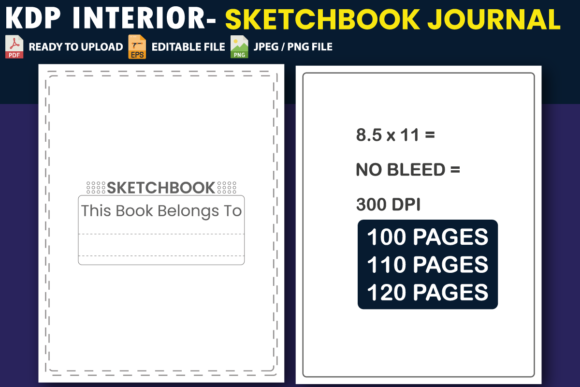
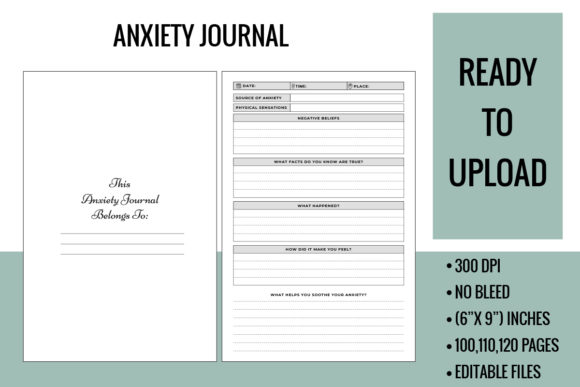
For self-publishers and digital product creators, the decision to utilize pre-made Anxiety Journal KDP Interiors Pages often comes down to balancing production speed with market differentiation. These specific interior files are designed as print-ready assets tailored for Amazon’s low-content book category, specifically targeting the mental health and wellness niche. Unlike generic lined notebooks, these interiors include structured prompts, mood trackers, cognitive behavioral therapy (CBT) frameworks, and reflection spaces intended to guide users through anxiety management. The distinct value proposition of this particular asset lies in its technical compliance and versatility; it is available in 100, 110, and 120-page variations, formatted at a 6”×9” trim size with no bleed, and delivered as a 300 DPI AI source file alongside a tested PDF.
Understanding what makes these Anxiety Journal KDP Interiors Pages distinct requires looking beyond the page count. In a saturated marketplace, technical precision is as important as content quality. Many creators face rejection or poor print quality due to incorrect margins, low-resolution graphics, or bleed settings that do not align with Amazon’s evolving specifications. This resource addresses those friction points by providing files that have been explicitly tested on KDP and verified for upload readiness. However, the utility of such a product depends entirely on the creator's business model, design capabilities, and willingness to customize the included AI source files to avoid creating duplicate listings.
Comparing Pre-Made Interiors to Custom Design and PLR Alternatives
When sourcing interiors for an anxiety journal, creators generally choose between three paths: designing from scratch, purchasing Private Label Rights (PLR) content, or acquiring specialized KDP-ready templates like the one described here. Each approach carries different tradeoffs regarding time investment, uniqueness, and technical risk.
Designing from scratch using tools like Adobe InDesign or Affinity Publisher offers maximum creative control and ensures a unique product. However, this route demands significant expertise in typography, layout design, and KDP’s specific margin calculations for no-bleed books. A single miscalculation in the gutter margin can render a 120-page journal unusable. For creators who lack professional design skills or wish to test multiple niches rapidly, custom design is often cost-prohibitive in terms of time.
PLR content represents another common alternative. While often cheaper, standard PLR interiors frequently suffer from generic layouts and overuse across hundreds of stores. They may also require reformatting to meet current KDP standards. In contrast, specialized Anxiety Journal KDP Interiors Pages that include editable AI source files bridge the gap between convenience and customization. The inclusion of an AI (Adobe Illustrator) file allows for vector-based editing, meaning text, lines, and shapes can be resized or modified without pixelation. This is a critical advantage over flattened PDF-only purchases, where making meaningful changes to the layout is nearly impossible without recreating the design entirely.
Technical Specifications and Quality Assurance Factors
The technical foundation of any KDP interior determines whether a book passes the automated review process and provides a good user experience. Several specifications make this specific interior package relevant for serious publishers:
- Resolution Standards: The 300 DPI requirement is non-negotiable for print clarity. Text-heavy journals with fine lines for writing require crisp edges to prevent bleeding or fuzziness on standard cream or white paper. Lower resolution files often result in customer returns.
- No Bleed Configuration: A 6”×9” no bleed format is the industry standard for trade-sized journals. It simplifies the cover design process and reduces the risk of content being trimmed during manufacturing. Ensuring the interior matches this specification exactly prevents alignment errors between the cover and the inner pages.
- Page Count Versatility: Offering 100, 110, and 120-page options allows for strategic pricing and testing. Thicker journals (120 pages) can command higher price points and are perceived as more comprehensive, while thinner versions (100 pages) reduce printing costs, potentially improving royalty margins for entry-level products.
- Pre-Upload Testing: Assets labeled as "tested on KDP" reduce the uncertainty of publishing. While Amazon’s guidelines change periodically, starting with a verified baseline minimizes the trial-and-error phase that often delays launches.
Assessing Fit: When to Use Ready-Made Anxiety Journal Interiors
Anxiety Journal KDP Interiors Pages are not a universal solution. Their suitability depends on your current position in the publishing lifecycle and your long-term brand strategy. Evaluating fit involves honest assessment of your resources and goals.
This option is likely a strong fit if:
- You are validating a new sub-niche: If you want to test whether "anxiety journals for new mothers" or "student anxiety trackers" will sell, spending weeks on custom design is inefficient. Using a compliant, editable template allows you to launch within days to gauge market response.
- You possess basic vector editing skills: Because the AI source file is included, you can modify prompts, adjust fonts, and alter layouts to create a unique edition. This transforms a commodity asset into a proprietary product.
- You prioritize technical safety over artistic novelty: If previous uploads have been rejected for margin errors or bleed issues, utilizing a pre-tested file eliminates technical variables, allowing you to focus solely on cover design and keyword research.
- You are building a series: The consistent formatting across 100, 110, and 120-page variants enables the creation of a cohesive brand line where customers recognize the internal structure across different editions.
Alternative solutions may be better if:
- Your brand relies on proprietary therapeutic methods: If you are a licensed therapist or coach selling a journal based on your specific methodology, a generic template—even an editable one—may not adequately capture your framework. Custom design remains superior for highly specialized clinical content.
- You lack software to edit AI files: Without access to Adobe Illustrator or compatible vector software, the primary advantage of this package (customizability) is lost. You would be limited to the PDF version, which restricts differentiation.
- You target large-format or color interiors: This specific asset is optimized for 6”×9” black-and-white no-bleed printing. Creators focusing on 8.5”×11” workbooks or full-color art therapy journals will need different specifications.
Navigating Tradeoffs and Market Saturation
A realistic evaluation must address the saturation of the anxiety journal niche. Because ready-made interiors lower the barrier to entry, many sellers use similar base assets. The risk of creating a "duplicate" listing on Amazon is genuine. To mitigate this, the editable nature of the AI source file becomes the primary differentiator. Simply uploading the provided PDF without modification is unlikely to yield sustainable results.
Successful publishers use these Anxiety Journal KDP Interiors Pages as a foundation rather than a final product. Practical modifications might include changing the introductory welcome page, altering the sequence of prompts, adding niche-specific affirmations, or redesigning the tracker layouts to match a unique cover aesthetic. The goal is to leverage the technical correctness of the template while injecting enough original intellectual property to satisfy both Amazon’s duplication algorithms and customer expectations for unique value.
Furthermore, consider the relationship between interior quality and cover design. The prompt notes that users "just need to create a unique cover." This highlights a crucial dependency: a high-quality, compliant interior cannot compensate for a poor cover. In the anxiety niche, covers must signal empathy, professionalism, and calm. The interior supports retention and reviews, but the cover drives the click. Allocating budget and effort toward professional cover design is essential when using pre-made interiors to ensure the external promise matches the internal quality.
Making an Informed Decision Based on Resources and Goals
Ultimately, selecting Anxiety Journal KDP Interiors Pages is a resource allocation decision. It trades upfront design time for post-purchase customization effort. For adults aged 20–50 entering or expanding in the low-content space, this tradeoff often aligns with modern publishing strategies that emphasize iteration and data over perfectionism.
When comparing options, verify that any interior you choose includes source files, not just PDFs. Confirm the DPI meets print standards and that the trim size matches your intended market. Recognize that "ready to upload" means technically compliant, not commercially guaranteed. Success still requires keyword research, competitive analysis, and marketing.
If your priority is establishing a technically sound baseline quickly while retaining the ability to differentiate through vector editing, this type of interior asset serves as a practical tool. If your priority is complete artistic originality or specialized clinical accuracy, investing in custom design services or developing your own layouts remains the preferable path. By understanding these distinctions, publishers can select resources that align with their specific capabilities and business objectives, avoiding both unnecessary expense and missed opportunities in the mental wellness publishing sector.