Garden Planting Journal - KDP Interiors: Elevating Low Content Publishing with Professional Design
The low content publishing landscape on Amazon KDP has matured significantly, moving past the era of generic lined notebooks and basic logbooks. Today’s successful publishers understand that profitability and sustainability in this niche depend entirely on specificity, utility, and aesthetic appeal. For creators targeting the horticulture and home gardening market, the Garden Planting Journal - KDP Interiors represents a critical shift toward high-value, niche-specific assets. This resource is not merely a collection of blank pages; it is a comprehensive, print-ready solution designed to meet the exacting standards of modern gardeners and the technical requirements of Amazon’s printing platform.
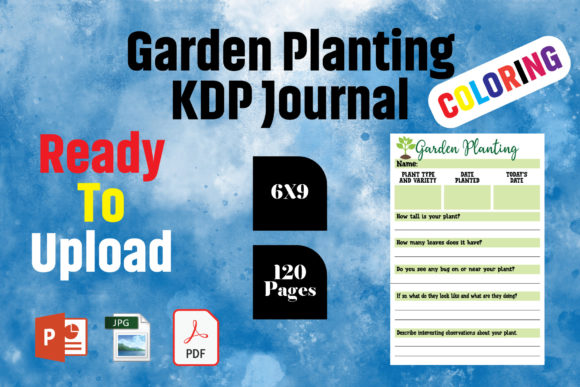
Relevance in this sector is defined by how well a product solves a user's problem while minimizing friction for the publisher. With dimensions set at a portable 6x9 inches and a substantial 120-page count, this interior strikes the ideal balance between portability and capacity. It acknowledges that gardeners need a tool they can carry into raised beds or greenhouses without being cumbersome, yet robust enough to document an entire growing season. By providing files in PDF, PPTX, and JPG formats at 300 PPI high resolution, this asset package addresses the most common pain points in KDP publishing: file compatibility, image clarity, and formatting errors. The inclusion of editable source files allows entrepreneurs to customize the experience, transforming a standard template into a unique brand asset.
The Evolution of Gardening Documentation and Market Demand
To understand why specialized interiors like the Garden Planting Journal Feathers 1 design are necessary, one must look at the broader cultural shifts surrounding gardening. Over the last decade, and accelerating post-2020, gardening has transitioned from a purely utilitarian chore to a wellness practice, a sustainability statement, and a data-driven hobby. Modern gardeners are increasingly interested in tracking soil pH, frost dates, companion planting success rates, and harvest yields. They are no longer satisfied with simple diaries; they require structured frameworks that facilitate learning and improvement over successive seasons.
This behavioral shift has created a gap in the market that generic journals cannot fill. Consumers are actively searching for tools that reflect their specific interests, including aesthetic preferences like botanical illustrations or feather motifs that evoke a sense of organic tranquility. The "Feathers 1" design element caters to this desire for beauty alongside function, acknowledging that the journal itself is part of the gardening lifestyle experience. Furthermore, as digital fatigue sets in, there is a renewed appreciation for tactile, analog record-keeping. However, these physical products must still compete with apps and digital spreadsheets. A KDP interior succeeds only when it offers superior organization and a more satisfying user experience than a screen-based alternative.
From a business perspective, this evolution means that low content books are becoming medium content books. The value proposition is no longer the paper; it is the intellectual property embedded in the layout. Publishers who recognize this trend and utilize high-quality, pre-designed interiors position themselves ahead of competitors still relying on automated, low-effort generators. The demand is for curated content that feels handcrafted, even when produced at scale through print-on-demand technology.
Technical Precision and Print-Ready Standards
One of the most significant barriers to entry and scaling in the KDP business is quality control. Amazon’s automated review systems have become increasingly stringent regarding bleed settings, margin safety, and image resolution. A rejected manuscript not only delays launch but can negatively impact account health. The Garden Planting Journal - KDP Interiors mitigates these risks through rigorous technical specifications. The "No Bleed" configuration for this 6x9 format ensures that all critical content remains safely within the printable area, eliminating the risk of text being trimmed off during the binding process. This is particularly vital for journals containing detailed tables, planting calendars, or intricate border designs where misalignment would render the page unusable.
Resolution is another non-negotiable factor. Printing at 300 PPI (pixels per inch) is the industry standard for crisp, professional-grade reproduction. Many amateur publishers attempt to upscale low-resolution images, resulting in pixelated or blurry interiors that garner negative reviews. By providing native 300 PPI files, this resource guarantees that fine lines in the feather illustrations and small text in tracking grids remain sharp. This attention to detail directly correlates to customer satisfaction and reduced return rates.
The provision of multiple file formats serves distinct strategic purposes. The print-ready PDF is the final deliverable for immediate upload, streamlining the workflow for publishers who want to launch quickly. However, the inclusion of PPTX and JPG files offers long-term business flexibility. PowerPoint files allow creators to modify text, adjust colors, or rearrange elements to create derivative works or seasonal variations without needing expensive graphic design software. JPG files enable the creation of matching marketing materials, social media graphics, or digital companion products. This multi-format approach transforms a single purchase into a versatile ecosystem of assets, maximizing return on investment for the KDP entrepreneur.
Streamlining the KDP Business Workflow
Efficiency is the currency of the low content publishing business. Creating a 120-page journal from scratch involves dozens of hours of layout design, typography selection, and margin calculation. Even for experienced designers, the repetitive nature of creating tracking grids and calendar layouts can lead to burnout. Utilizing a professional interior like this allows publishers to bypass the production phase and focus on higher-value activities such as keyword research, cover design, advertising, and brand building.
The "Instant Download" aspect of this product aligns with the agile methodology many successful KDP businesses now employ. Speed to market matters, especially in seasonal niches like gardening. Being able to acquire, verify, and upload a high-quality interior within minutes allows publishers to capitalize on emerging trends or prepare for peak seasons well in advance. The fact that the interior comes with a "100 Check quality on KDP" assurance further accelerates this process. Publishers can upload with confidence, knowing that the file has been vetted against current KDP specifications. This reduces the anxiety associated with technical rejections and allows for faster iteration cycles.
Moreover, consistency builds brands. When publishers use cohesive, high-quality interiors across a series of gardening books, they establish trust with their audience. Readers who have a positive experience with one journal are likely to purchase others from the same creator. The professional structure of the Garden Planting Journal provides a solid foundation for building such a series. Whether expanding into vegetable-specific logs, flower arranging planners, or composting trackers, maintaining a baseline of quality and usability is essential for long-term growth.
Practical Implications for Creators and End Users
For the end user—the gardener—this journal serves as an external brain. The structured prompts and dedicated sections reduce the cognitive load of remembering what was planted where and when. In practical terms, this leads to better crop rotation, fewer pest issues due to improved observation, and higher yields. When a product delivers tangible results in the garden, it generates organic word-of-mouth marketing and positive reviews, which are the lifeblood of KDP sales. Publishers should emphasize these practical benefits in their book descriptions and A+ content, highlighting how the specific layout features translate to gardening success.
For the creator, the implications extend beyond a single product. Working with high-standard templates educates publishers on what constitutes good design. By analyzing the spacing, font choices, and functional elements of the Garden Planting Journal, entrepreneurs internalize best practices that improve their future original work. It serves as both a product and a learning tool. Additionally, the editable nature of the PPTX files encourages experimentation. Publishers can test different layouts or add localized content (such as regional frost date charts) to differentiate their offering in a crowded marketplace.
It is also important to address the realistic expectations of using pre-made interiors. While this resource is print-ready and high-quality, success on KDP still requires effort in other areas. A beautiful interior cannot compensate for poor keyword targeting or an unappealing cover. Publishers should view this journal as a premium component of a holistic publishing strategy. The goal is to combine excellent internal content with effective external marketing to create a product that stands out based on merit rather than manipulation.
Integrating Quality Assets into a Sustainable Strategy
The low content book market is no longer a gold rush; it is a mature industry that rewards professionalism and user-centric design. Resources like the Garden Planting Journal - KDP Interiors represent the new baseline for competitiveness. By leveraging 6x9 dimensions, 120 pages of no-bleed content, and 300 PPI resolution across multiple file formats, publishers can ensure their products meet both technical standards and consumer expectations. The integration of aesthetic elements like the Feathers 1 design further aligns the product with current lifestyle trends, making it appealing to a demographic that values both function and form.
Ultimately, the value of this asset lies in its ability to bridge the gap between creative ambition and technical execution. It removes the friction of production while maintaining the integrity of the final product. For entrepreneurs, educators, and hobbyists entering or expanding within the KDP space, investing in verified, high-resolution interiors is a pragmatic step toward building a resilient publishing portfolio. As the market continues to evolve, those who prioritize quality, usability, and adaptability will be the ones who sustain growth and cultivate a loyal readership in the evergreen niche of garden planning.