Evaluating Daily Planner KDP Interiors for Low-Content Publishing
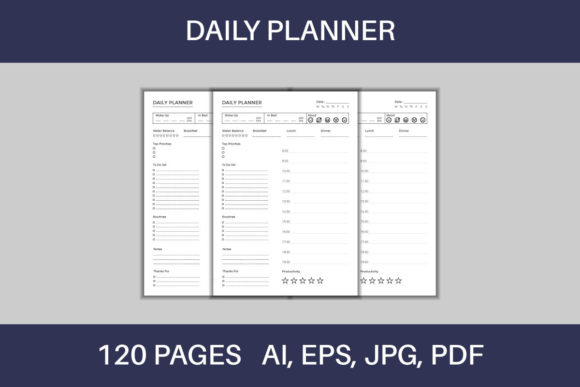
For self-publishers utilizing Amazon Kindle Direct Publishing (KDP), the interior manuscript is often the most time-consuming component of product creation. Daily Planner KDP Interiors serve as pre-formatted templates designed to streamline this process, allowing creators to publish functional planning journals without designing layouts from scratch. These digital assets typically include structured pages for scheduling, goal setting, and reflection, formatted specifically for print-on-demand specifications. When evaluating resources labeled as "Daily Planner KDP Interiors _ A4 Size Zip File Included _AI _EPS _JPG _PDF," it is essential to understand that this specific file structure indicates a versatile, multi-format asset package intended for both immediate use and potential customization.
Understanding the Asset Composition
To make an informed decision, one must first understand what the inclusion of AI, EPS, JPG, and PDF files signifies for a KDP business. This combination suggests a tiered utility approach rather than a single-use product.
- PDF Files: These are generally ready-to-upload manuscripts. For publishers seeking speed, the PDF allows for immediate listing on KDP without additional software. However, these are static; modifying margins or adding branding usually requires recreating the document.
- AI and EPS Files: Adobe Illustrator and Encapsulated PostScript files represent vector-based source files. These are critical for publishers who wish to differentiate their products. Vector formats allow for infinite scaling and editing of individual elements, enabling users to change fonts, adjust line weights, or modify layout structures to create a unique intellectual property.
- JPG Files: While less common for full interiors due to resolution concerns at print size, high-resolution JPGs can serve as reference guides or background textures. In some packages, they may act as flattened previews to verify content before opening heavier vector files.
- A4 Size Specification: It is vital to note that A4 (8.27 x 11.69 inches) differs from the standard US Letter size (8.5 x 11 inches) common in North American KDP markets. Publishers targeting international audiences or specific professional niches will find A4 appropriate, while those focusing solely on the US market may need to resize or crop these templates, which introduces additional workflow steps.
Strategic Benefits for Publishers
The primary value proposition of acquiring comprehensive Daily Planner KDP Interiors lies in workflow efficiency and technical compliance. Designing a 365-day planner from zero requires significant typographic hierarchy knowledge and margin calculation to ensure text does not bleed into the gutter during binding. Pre-made interiors mitigate these technical risks.
Furthermore, the inclusion of editable source files addresses the saturation issue prevalent in the low-content book niche. Many KDP sellers fail because they upload identical, unmodified templates that hundreds of others are also using. Access to AI and EPS files transforms a generic purchase into a foundational design element. This capability supports brand consistency across multiple products, allowing a publisher to establish a recognizable aesthetic that builds customer loyalty over time. For creators who possess design skills but lack the time to draft grid systems, these interiors function as professional scaffolding rather than finished goods.
Tradeoffs and Critical Considerations
Despite the advantages, relying on pre-made Daily Planner KDP Interiors involves distinct tradeoffs that must be weighed against business goals. The most significant risk is licensing and exclusivity. Unless the asset comes with an exclusive license, other publishers have access to the same base materials. Even with editing capabilities, the underlying structure remains similar across users. This can lead to marketplace cannibalization where multiple books compete with nearly identical value propositions.
Technical compatibility is another consideration. While AI and EPS are industry standards, they require specific software proficiency. A publisher without access to Adobe Illustrator or compatible alternatives like Affinity Designer cannot utilize the editable components effectively. In such cases, the value of the package diminishes to that of a static PDF, potentially making the higher price point unjustified compared to simpler, PDF-only alternatives.
Additionally, the A4 sizing constraint requires careful market research. If a publisher’s analytics indicate their audience prefers 6x9 inch travel planners or US Letter desk planners, an A4 template necessitates reformatting. Resizing a complex planner layout is not merely a matter of changing page dimensions; it often requires adjusting text boxes, realigning grids, and verifying that safe zones remain intact. This labor can sometimes negate the time-saving benefits of buying a pre-made interior.
Situational Fit Assessment
Determining whether this specific type of Daily Planner KDP Interior aligns with current needs depends largely on the publisher's stage of development and technical capacity.
When This Asset Is a Strong Fit
This resource is highly suitable for intermediate publishers who understand KDP guidelines but want to accelerate production. It is particularly valuable for those expanding into international markets where A4 is the standard paper size. The multi-format inclusion makes it ideal for designers who want to deconstruct existing layouts to learn professional typesetting or who plan to create a series of related products requiring a unified visual language. If the goal is to build a long-term brand with proprietary designs derived from professional bases, the AI/EPS inclusion justifies the investment.
When Alternatives Are Preferable
Beginners with no design software experience should likely seek PDF-only interiors formatted specifically for their target trim size to avoid technical frustration. Conversely, established publishers with a distinct, proprietary style may find pre-made interiors restrictive; in this case, hiring a freelance designer for custom work or creating original templates yields better long-term asset value. Additionally, if the target demographic is exclusively North American consumers looking for standard letter-size office supplies, seeking US-specific templates will prevent costly resizing errors and ensure better market fit.
Practical Decision-Making Framework
Before acquiring Daily Planner KDP Interiors with this specific file configuration, publishers should conduct a three-point evaluation. First, verify the commercial license terms explicitly. Ensure the license permits modification and resale on KDP, and check if there are limitations on the number of end products or requirements for attribution. Second, audit the file contents personally. Download sample files if possible to confirm that layers in the AI/EPS files are organized logically and that text is editable rather than outlined. Poorly organized source files can take longer to fix than designing from scratch. Third, calculate the true cost per unit including time. If resizing an A4 template takes four hours and designing a custom US Letter template takes six, the savings may be marginal. However, if the template provides a structural foundation that reduces design time by 80%, the ROI becomes clear.
Ultimately, Daily Planner KDP Interiors are tools, not solutions. Their effectiveness depends entirely on how they integrate into a broader publishing strategy. By objectively assessing technical requirements, market alignment, and licensing parameters, publishers can determine whether this specific A4 multi-format package serves as a catalyst for growth or an unnecessary complication in their production workflow.