Evaluating Music Notebook for KDP Interiors: Formats, Customization, and Market Fit
For self-publishers entering the low-content book market, selecting the right interior template is a strategic decision that impacts both production speed and long-term brand viability. The Music Notebook for KDP Interiors represents a specific category of pre-formatted resources designed to streamline the creation of musical journals. Unlike generic lined notebooks, these interiors cater to a niche audience of musicians, students, and composers who require specialized layouts for notation, practice tracking, and composition. Understanding the technical specifications and customization potential of this 6x9 inch format is essential for determining whether it aligns with your publishing goals or if alternative solutions might better serve your business model.
Defining the Product Scope and Technical Specifications
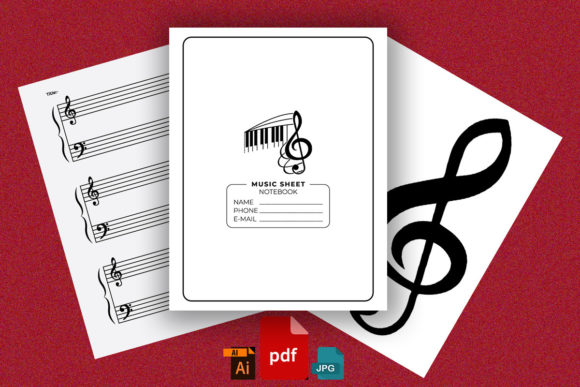
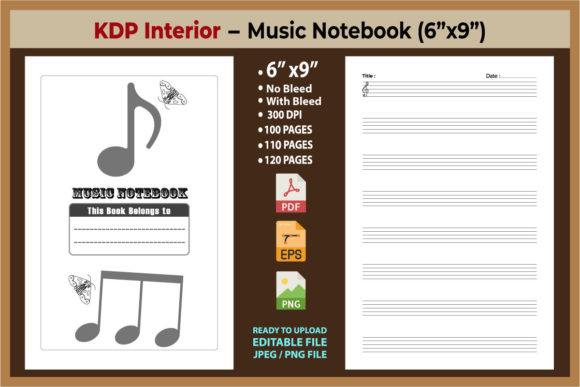
The Music Notebook for KDP Interiors is distinct from standard journal templates due to its functional design tailored for musical application. This specific resource is configured as a small 6x9 inch journal, a size that balances portability with adequate space for staff notation and written reflections. The product typically includes multiple page count variations—100, 110, and 120 pages—allowing publishers to test different price points and spine widths without redesigning the core content. This flexibility is crucial for A/B testing in a competitive marketplace where perceived value often correlates with page count.
A critical technical aspect of this interior is the availability of both bleed and no-bleed options. For music notebooks, this distinction is significant. A no-bleed version keeps all notation and text within a safe margin, which is generally safer for beginners and ensures that no content is lost during the trimming process. Conversely, the bleed option allows background elements or decorative borders to extend to the edge of the page, offering a more polished, professional aesthetic that can differentiate a listing from basic competitors. The inclusion of tested, high-quality print-ready PDFs reduces the risk of rejection during Amazon’s automated review process, addressing one of the most common pain points for new KDP publishers.
Comparing Pre-Made Interiors to Custom Design Alternatives
When evaluating the Music Notebook for KDP Interiors, it is necessary to compare it against two primary alternatives: creating interiors from scratch or using free/public domain resources. Each approach presents distinct tradeoffs regarding time investment, cost, and market saturation.
Pre-Made vs. Scratch Design
Designing a music notebook from scratch using software like Adobe InDesign or Affinity Publisher offers total creative control and uniqueness. However, this route requires advanced typographic skills to ensure staff lines are evenly spaced and legible at 6x9 dimensions. It also demands significant time to set up master pages, margins, and gutters correctly. For publishers whose primary strength is marketing rather than graphic design, the opportunity cost of learning layout software may outweigh the benefits. The pre-made Music Notebook for KDP Interiors serves as a middle ground, providing a professional baseline that eliminates technical errors while still allowing for modification through editable source files.
Commercial Templates vs. Free Resources
Free music manuscript papers are widely available online, but they often come with licensing restrictions that prohibit commercial use on KDP. Even when commercially licensed, free resources tend to be overused, leading to market saturation and duplicate content flags. Paid interiors like this music journal typically offer a higher baseline of quality and unique design elements that help avoid these pitfalls. While the upfront cost is higher than free alternatives, the reduction in legal risk and the inclusion of editable AI and EPS vector files provide a foundation for building proprietary assets rather than relying on commoditized public goods.
The Role of Editable Files in Long-Term Strategy
A defining feature of this resource is the inclusion of editable AI (Adobe Illustrator) and EPS vector files alongside standard PDF, JPEG, and PNG formats. This multi-format delivery shifts the product from being a simple "done-for-you" template to a customizable asset library. For serious KDP businesses, the ability to edit the source file is arguably more valuable than the ready-to-upload PDF itself.
Editable vectors allow publishers to modify staff spacing, add custom branding, change fonts, or integrate unique illustrations. This capability addresses the primary weakness of pre-made interiors: lack of differentiation. By altering key visual elements, a publisher can create a series of related notebooks that share a cohesive brand identity while remaining distinct enough to avoid cannibalizing sales. Furthermore, vector files scale infinitely without quality loss, making them future-proof for potential expansion into larger formats like 8.5x11 inches or digital tablet versions. Publishers who only utilize the static PDF miss this strategic advantage and remain dependent on the original designer’s aesthetic choices.
Assessing Market Fit and Audience Alignment
The 6x9 inch dimension of this Music Notebook for KDP Interiors targets a specific user behavior: portable practice logging and quick idea capture. This differs significantly from 8.5x11 inch composition notebooks used for formal scoring or classroom instruction. Understanding this distinction helps determine if this product fits your target demographic.
- Ideal for: Instrumental students needing daily practice trackers, songwriters capturing lyrical ideas on the go, and adult hobbyists maintaining a musical diary. The compact size fits in instrument cases and backpacks, making it a practical accessory rather than just a book.
- Less Suitable for: Orchestral composers requiring full-score layouts, choir directors needing large-print repertoire books, or academic textbooks. These users typically require larger formats and different binding considerations that a 6x9 paperback cannot accommodate.
If your research indicates demand for portable, personal-use music journals, this interior aligns well with those needs. However, if keyword research suggests high volume for "orchestral score paper" or "guitar tab notebook," this specific lined journal format may not satisfy that search intent despite being in the broader music category.
Practical Considerations for Implementation
Integrating the Music Notebook for KDP Interiors into a publishing workflow requires attention to detail beyond simply uploading the PDF. While the files are described as tested and ready, best practices dictate verifying specifications before publication. Margins can shift based on page count; a 120-page book has a thicker spine and wider gutter than a 100-page book, potentially affecting how close notation sits to the binding. Publishers should always download the proof copy or use KDP’s previewer tool to check readability near the spine, especially for music notation where clarity is paramount.
Additionally, the presence of JPEG and PNG files suggests utility beyond print interiors. These raster formats can be repurposed for marketing materials, social media mockups, or digital product listings. Leveraging these assets creates a cohesive customer experience from ad click to physical product. However, users should note that raster files are resolution-dependent and should not be resized significantly for print use; the PDF or vector files remain the authoritative sources for the book interior.
Making an Informed Decision
The decision to use this Music Notebook for KDP Interiors should be based on a realistic assessment of your current capabilities and business objectives. It is an efficient solution for publishers who want to enter the music niche quickly with a professionally formatted, technically compliant product. The inclusion of multiple page counts and bleed options provides necessary flexibility for testing market response. Most importantly, the editable source files offer a pathway to customization that protects against the homogenization common in low-content publishing.
However, this resource is not a substitute for market research or brand development. Success depends less on the template itself and more on how effectively it is adapted to meet specific user needs. Publishers who treat this interior as a starting point for iteration rather than a final destination will likely see better long-term results. Those seeking absolute uniqueness or targeting non-standard formats may find greater value in investing time to learn design software or hiring a specialist. Ultimately, this music journal interior is a tool—a capable and versatile one—but its effectiveness depends entirely on the strategic context in which it is deployed.